Wednesday, May 21, 2014

Blood of the Sea

   Beneath my arms she rests, quiet,
  Peaceful in her patience, awaits
  The Life that surrounds her, protects her,
  Gently shaping her majesty to come.

  Creature of the Living Sea, Shaped
  Of Struggle, Chaos brought to law
  of Art and Freedoms, Battles won,
  The whale's Blood not lost in Song
 
  But carried boldly, caring firmly
  A World Unknown to us on Land -
  Perfect in their sphere of Justice,
  Mercy's Sword defending Hand

  Thus gives a Birth anew the Hope
  Of living ever with the Sea
  That molds the Life of things to come
  And Creates the Love She soon will be.
                                     - WKDe Vaney
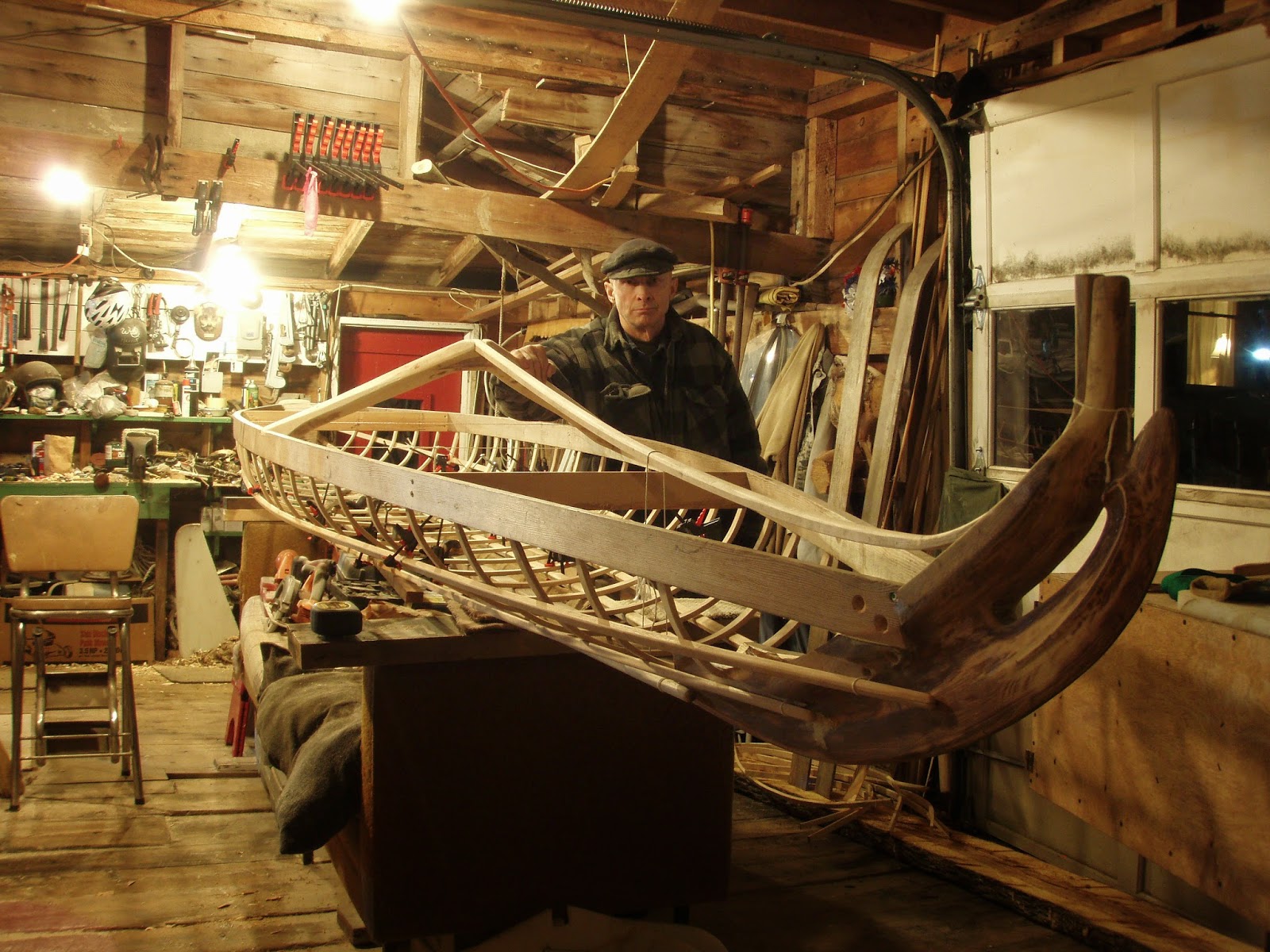
   Trust that a major surgery can alter the course of one's being, but that being said, it doesn't have to be without it's benefits. So has it been for me - a defective joint about to fail completely, completely removed and replaced. I am jokingly referred to as the "Bionic Boatbuilder" now, as that hip is now Titanium and Cobalt steel. It works better than the original, and has given this old Veteran a new lease on life. So, with that renewed energy, I am back in the shop, to finish what I started. My Wife is pleased, And so am I.
   A lot has been happening, as the work continues with Kielidgh Irene. It would seem odd that a Norwegian designer of over 100 years ago could have led me to an appreciation of the genius behind the design and construction techniques of the People of the Arctic, but such it is. Colin Archer was well know for his sea worthy double enders, and his designs were extensively used for the rescue boats that served Norway during the turn of the last century.
   In John Leather's book "Colin Archer and the Seaworthy Double-ender", Colin's exceptional abilities are explained with the very vessels he designed.
   In review of the reasoning behind his country's considerable sea sense, I couldn't help but refelct on my own experience with the council offered to me by my own mentor, Norwegian Naval Architect Ben F. Jensen. He sent me into the shipyards and boatyards for several years before I began to seriously design, and the process of this experience exposed me to the attributes of many boat characteristics, throughout the world. Ben and Colin brought me into a whole new world of boat design, a fisherman who learned from the masters what a good boat really had to offer.
   So, in this process you learn that design follows function. And that goes for something even as humble as a Kayaq. Especially for the Kayaq, as it 's design and function often determines by the quality of it's build and characteristics, whether the kayaqer lives or dies. Of all, she is exposed to the most uncompromising conditions for her size of any boat out there, and has the greatest demands upon her expectations. Because she is the families' means of survival - if she fails, you starve. If she fails completely, you don't live long enough to starve.
   It's really just that simple.
   Having grown up in that way of life, I can appreciate the qualities that make a subsistence kayaq the unique and beautiful vessel she is. She adapts to the elements as the creature of the sea that she is, and with the creatures she must live with as well. Kielidgh Irene will flow with the whales and the sea lions as her predecessors have before her, those with myself, and with the memories of those ancestors who have gone before us. We can hardly appreciate the difficulties of the life they endured - but can give them the respect through her lines that their experience has imparted through their legacy. I hope to do it well.
   So with heart in the future of her past, She takes shape. And begins to breathe.

   She is shaped from the land, a creation of the material that gives her life.
   The ash ripped down for the frames and paddles is cured, as the pine knee from last fall is brought out for shaping into the critical deck beam for which it was harvested.
   Then, the shaping begins...


   Once the knee is measured and fit to set into the notches created for it's acceptance on the gun'l, then the forward Spruce ridge pole for the deck is set into place, the unit becoming a whole...


   These pictures were taken as the final fitting was being done, after the steam and boiling of the frames into place. That was a chore in itself, as the green ash had to be quarter sawn to allow for the grain to run flat with the bend. Then the steam box was fired up, and once the box itself was operational, as explained in a previous article, they were pulled and bent into place. The bow frames were the most difficult, and had to be boiled to take the additional stress of the more radical bends...


   Once the frames are trimmed and set into place, however, the jungle becomes more civilized, and the work begins to make more sense...


   Here is where the real ingenuity of the People comes out. In the areas where the seaways they had to navigate were choppy and short, twisting their kayaqs' framework against itself, the friction of the frames rubbing against the keel could become a serious problem. The chaffing wood often began to loosen as it pulled itself apart.
   To solve this problem, the ancients would inlay a small piece of polished ivory into the keel, under the frame before they were tied together, thus protecting the secured pieces as the frame rested upon the polished ivory instead of being in direct contact with the keel.
   As a scrimshaw artist legally allowed to work in fossilized ivory, I have on hand the opportunity to incorporate this advantage into Kielidgh Irene as well. So my usual artistic practice


   is challenged in a new and diverse way, as I set into her frame, the symbolic scrimmed ivory of her heritage.


   Once embedded into the notch provided in the keel, the frame is set into place over the 3/4 inch square piece of scrimmed ivory, and then secured as a unit covering the tiny artwork of the boat's practical character.


   The knee supporting the byforcated bow is set into place with treenails, and the entire bow unit lashed together with fresh lashing lines. Here is the one important break from tradition, as I must resort to nylon for this task. Much stronger, however, lasts longer - and doesn't rot. A definite plus.
   With the oak trailboards secured in a like manner into the bow framework, the little kayaq begins to feel the hope of life stirring within her.
   She is ever closer to her destiny, the ice of her progenitors calling her back into the rhythm of the Arctic seas...


     - WKD

Monday, September 30, 2013

Beyond the Stars

   The process is a sacrifice for the tree, but when given an opportunity, it goes far beyond it's original destiny...
   I am reminded of an old Same' (Pronounced Saw Mee) legend of the boy who when kiting one evening caught his kite on a star. He pulled it down, to learn that it was the original Star of Bethlehem. In conversing with the star, and his village being in desperate need, the Star agreed to remain and help the village through the winter, but come the spring it would need to return to the heavens or it would die. As the boy and his sister were now orphans, and in serious need themselves, he agreed. The village prospered from their association with the Star, who related the teachings of the Lord to them and admonished them to follow those teachings towards a better way of life.
   The boy recorded those teachings, then to his credit, set up the kite to sail the star back into the Heavens as agreed. He and his sister had matured much during this winter visit, and opportunities had opened that he desperately wanted his sister to enjoy. But she refused to abandon her brother.
   Knowing that he was needed to be her comfort and guide in a capacity far beyond himself, he gave her the book that held the record of what he had learned from the Star. Then as the Star sailed into the Heavens, he gave her his love, and, attaching the trailing cord to his wrist, sailed into the heavens with the star. In this way he could be with her wherever she went, and to this day, riding behind the star Mizar of the constellation Ursa Major, is the tiny star Alcor, also known as "the Rider".
   So I find myself pondering the role of this slender piece of wood, set into the framework of a much larger pattern of structure, as it sails just behind the larger knee of the byforcated bow in the overall structure of the kayaq. It's gentle sweeping curve rises into the cockpit as a line of sight, where I will be able from my position in the boat to power and guide the vessel through the sea.
   Tried in the heat of boiling water and bent carefully into place, it now rests as it cures into the shape it's position and structural integrity demand of it.
   And in this position, once set into place with it's ties intricately weaving it into the rest of the Kayaq's framework, will it serve not only as an essential part of the upper forward "backbone" of the vessel, but as a navigational guide as well.
   Gentle, straight, and supple, this simple piece of curving spruce is every bit as essential to the boat as the keel.
   And every bit as important as the stars to guide me.
-WKD
   Wooden boat builders are called wood butchers for a very good reason...
This was a tree...


Maine Awaking

   Mists over the mirror, drifting across
   The gently rippling waves of morning
                                                      as
   a kaleidoscope along the coastline is unveiled
                                                      from behind
   the curtains of the breaking day.
   The woods of the increasing brilliance radiate a myriad palate, color
                                                                                         streaming
   Intensifying, glowing through a dazzling dawning light.
   An autumn day awakening along the coastline of my reality,
                                                                        a dream
   that has at last come true.
   Warmth in Nature's age, seals peeking from beneath a fluid film,
                                                                 graceful sliding along
                                                                 the caressing element of
                                              their home.
   And mine.
   Good morning.
-WKD

Saturday, September 21, 2013

Life and Legacy

   It has been said that to error is human - but it takes a computer to really foul things up. Such was the situation for quite some time in our more remote region of Maine - our service area was disrupted for over a week, until someone finally answered the inquiries of their customers with something more than an automated service message, and the connections were re-routed. So, an entry that was ready weeks ago is finally having an opportunity to come forward. I apologize to those who have been following this web log, and hope to continue uninterrupted.
   Seclusion, however, isn't all bad, as I remember a warm summer day with my father in 1959, as we were running our 32 foot limit seiner down Kachemak Bay outside of Homer, Alaska. I was seven at the time, and couldn't see another boat anywhere for miles around. 
   My Dad has a way of making even the most challenging prospects inviting, as he offered the wheel of the boat to me. "We're headed into that bay ahead," he explained, " so just keep her going ahead and we'll be fine. I'm going on deck to get the lines ready." And with that, he stepped down from the bridge to the aft deck and started coiling together some extra line.
   I'll never forget the experience of standing behind the wheel, barely able to see over it, on top of the bridge cabin overlooking the sunlit bay running before me. With the open air breezes gently nudging my hair, I couldn't help but thrill to the throbbing engine and the deck moving in a gradual roll beneath my feet. It was an experience unlike anything I had ever enjoyed in my young life, and it was just me and my Dad together doing it.
   He left me up there for some time, knowing as I didn't that we had all the sea room we needed to stay out of trouble. I know now from my own experiences at sea, that he was working where he always had visual of the waters ahead, as well as his son above him on the bridge. He was allowing my experience to be as fulfilling as possible, without being too far away in case something unpredictable happened. 
   When he did come back up to take the wheel, he thanked me and told me I had done a good job keeping the boat on course. I knew my Dad never said anything he didn't mean, and felt wonderful for his praise. 
   Then he smiled and said, " Before you go below, take a look behind you."
   I did, and will never forget what I saw - the trailing wake of the boat was a very pronounced zig-zag, as if I was a convoy skipper trying to dodge torpedoes! In my youthful inexperience, I was over correcting my course with each swing of the wheel, not understanding that the boat steered from the stern - not the bow from which I stood, as an automobile would. 
   Dad was still smiling as he took in my expression, which clearly indicated my surprise. I will never forget the council he offered, that through the years has always stood me well. " It's not the wake that matters, son," he said, "as long as you stay on course. Keep the boat going in the direction she needs to go, and the years will give you your sea legs. You'll do fine." 
   Now I'm 61, and he will be 83 in a few more days. He still swings up into the cockpit of my daughter Sariah's White Freightliner Tractor with ease, and keeps the town he's been Mayor of for more years than I remember running like a well oiled machine. His council is still just as solid for me now as it was when I was a boy, and I thank God he's my Dad. He's always believed in me, and that's a gift worth more than gold.
   So, I still live my life with the sea, and build boats like I'm doing now, from warships years before to my Kayaq now, and building or restoring about anything else in between. It keeps the memories alive, and breathes the life into what I do for those who will live after me. And pray to do it well enough to honor the man who still believes in me. 
   Thank you, Dad.

   So the project continues, as the steam box is finally finished and put into service. Frames have their lengths in marking pen written on the end, so there's no mistake as to where in the boat they go, to be bent into place. 
   Then the fire is lit, the water in the tank below it brought to a rolling boil, and after the frames are hot, which for something as small as these are, take no more than 20 to 30 minutes - too long, and the steam dries them out - they are pulled, one at a time, and carefully bent into place within the framework of the boat. Steam bent frames only give you about one to two minutes max to work them into place before they cool and stiffen, so even as carefully as you work each frame, you must work quickly.
   But the reward is a gratifying give of the frame into the shape of her future, a living material formed into the rib of a living creature. The first frame goes into place, and she comes closer to her destiny as the creature of the sea she has been conceived to be. 
   Winter in Maine can be unforgiving, and the temps are dropping now into freezing at night often enough to warrant concern. But the shop is warm with the wood stove crackling in a lively way, and Keilidgh Irene coming closer to her summer form. 
   She will live.
-WKD


Thursday, August 22, 2013

Sea Sense - Doing the Math

   If there's anything at all I've learned at sea, if you are going to get where you need to go, you have to do your homework. It doesn't matter what size the boat is - if you miscalculate your equations doing the math in your navigation, the mistakes can be painful.
   Literally.
   That's one thing I've admired about Julian Stockwin, author of the well acclaimed "Kydd" series novels. He writes of the days when our seas were defended with wooden ships of fighting sail and iron men.
   And no GPS.
   Julian is definately one who does his homework. He's a seaman who has seen the harder ways of a life at sea, and in reading one of his novels, "Quarterdeck", I couldn't get past the navigational solution worked out between Kydd, now an officer, and his navigator Rawson at the end of Chapter Four, without remembering a time when I would have enjoyed a bit of peace having Julian along.
   There have been times when knowing the sea and the way she works has saved me. During the ice storm related in the beginning of this web log was only one such incident.
   The one time that memory recalled Julian's novel "Quarterdeck", only fortunately without the fog, happened several years before that day in the Arctic. But it proved just as memorable, and with just as unexpected an ending.
   Kodiak Island, Alaska is located at the northwestern head of the Gulf of Alaska, where the Japanese Current comes up along the Aleutian Chain and then curls down into the Southeastern Panhandle, as we Alaskans refer to it. The weather that these colliding fronts can create is serious business, especially beginning in August, and hits the southeastern side of the Island and it's archipelagos quite hard. 
   But it's through this open coastal waterway I had to travel each fishing season, to get to my commercial fish site on Kupreanof Straits, over 140 nautical miles away. In an 18 foot open double ender.
   Then after the fishing season was over in August I had to use this same route to return, to get to our home at the village of Old Harbor, tucked just inside the straits of Sitkalidak Island. Over two thirds of the passage was across the open face of the gulf of Alaska, and it's not a run to take lightly. The weather picks up suddenly and hits hard across this stretch, and several of my friends are no longer with us now because of it.
   On this occasion I had completed a good season, and was towing a new skiff I had designed and just shelled in to complete once I had it home, for the next year's fishing season. She was a gull wing 18 foot built to run with twin outboards, but until it was finished I would not have use of her. So she had to be towed behind the tough little double ender.
   I had been watching the weather fronts - Alaska has some of the best weather channels I've seen, covering marine weather at sea as well as for flight operations. I studied the moving fronts, calculating the effect on the tides and the wind patterns that I would encounter on the way home. The currents would play a serious part in the way the passage was effected by the oncoming weather, especially across the open waters of the Gulf, and timing the tides with the hours of daylight remaining that time of year was critical. A mistake would find me in a building sea at night, with several rocky areas across my path - and a falling 20 foot tide exposing their hazards to a wooden hull.
   Not good.
   I'm known for being safety conscious, especially at sea. I did the math, worked out the time and distances with the tidal effects, and calculated the positions I should find myself in at each point I knew needed to be specific.
Then I went over the boats again to make sure everything was in order. The little double ender was a proven, tough little boat. We had weathered a lot of rough seas together, and I knew the route well enough that, if things got too bad, or the unexpected happened, I could find a hole to get out of it. Even if I had to get rid of the new skiff to do it, I would make it.
   As long as knew where I was - even in the dark.
   Which meant doing the math.
   It was a good thing I did.
   The day I was to depart, unexpected family complications held me up, and I didn't cast off until several hours past my planned departure. I knew from the allowance I had made, that the tides would work with me past the worst of the points across my path. But approaching the Straits into Sitkalidak, if the weather started to build, I would be hunting a hole.
   At night.
   The long Alaskan days were starting to shorten enough that I knew I wouldn't make it in time if the weather turned. The forecast was good, and was usually reliable, but anything could happen. I rechecked my positioning as I went, the tide finally changing and my time and distance calculations with it. Dusk had settled in long before I cut across Boulder Bay as I passed Dangerous Cape, and adjusting for the building ebb tide, I approached the entrance of Sitkalidak Straits in darkness.
   Here's where a moon would have been nice. Any light at all. But the new moon was invisible and the stars that sparkled above me, while helping me to maintain my course, only gave enough of a visual aid to show the black outlines of a cliff side to either side of me. There was no references of any kind to indicate how far I was from either side. Or the rocky shores defending them.
   I could tell by the motion of the boat beneath me the way of the water, the depth enough to feel at peace with my position in the channel thus far. But it felt like I was in a black tunnel with only the top of the box open, and no way to see where I was at going through - middle, or sides. But I was familiar enough with the double ender to know what she was telling me, and continued with my faith in her reading the water I couldn't see - and the math that had told me earlier where I should be.
   But after the first hour, now deep into the channel against a strong ebb tide, I couldn't help but long for a light, any light of some kind to confirm my position.
   Be careful what you pray for - you just might get it.
   I was studying the blackness around me when I noticed ahead, that the channel was starting to brighten. And not just a bit, but with a blaze of light as, from around the bend to my port bow, well ahead of me, a large fishing boat came into view from around his side of the channel. His "Norwegian Sunrise", as we refer to the massive array across the masthead light bar on our fishboats, was brilliantly illuminating everything for miles across the channel as he turned my way, and headed for the open sea.
   Suddenly everything was vividly portrayed in every detail - and to my relief, I was right on course, in the middle of the channel.
   And right in the fish boat's way, if I didn't adjust course! Fortunately we passed without incident, and in the fading light I found a perfect little bay to drop the hook for the night. I secured my berth, fixed a welcome meal, and stretched out under the stars after a prayer of gratitude to a loving Heavenly Father who saw the needs of a simple fisherman. Sometimes He teaches us in His answer, and sometimes He teaches us without one, knowing whatever it is, it's something we can handle and learn from ourselves. The important point is that we are willing to learn.
   I fell asleep having learned that either way, He answers prayers.
   And it pays to do your homework.
   Thank you, Julian.
   -WKD


Monday, August 19, 2013

Master's Craftsman...

   From a mist, darkness parting; So mysterious the outline, shape of things
                                       To come,
   Like a good horse, closer nuzzling under the arm there feels the breath of life stirring.
   Creation of heart and hands of the sea, speaking trust, she feels peace
                                      and in tenderness awaits
                                      Her growth in patient increments.
               Molded of a Master's Hands, we grow together as One,
   She within me grows before me, vision of my dreams with each careful tooling touch -
   I within Him grow before Him, Master of the Winds and Sea that obey His every Will,
   Work I in careful patience the craft of life He teaches with His Son.
   These with mortal hands carry the reality of art into life, breathing the crisp air of the ocean's majestic power, rhythm of the waves in heart pounding move together;
   Bonding, building, expanding our dreams through the sweat and hopes
                                        of Triumphs won,
   In vision and sweep of blade, pull of mortal arm into dawn of eternal
                                        Victory
   We depend upon each other, live for each other as does He for us.
   Thus mortality speaks its lessons, stirring the dust of man into the
                                        Shape of things to come,
                                        Forever One.
                                                         - WKD

   So it continues, as the frames are now cut and, labled with their length on the ends of each piece, are soaking in a salt water solution awaiting their time in the steam box when it comes. With the Long'l stringers in place, the three jig frames are marked and set to hold each, as the frames are bent around them - set inside what will be the upper surface of the keel, outside of the long'ls, and tucked back inside the long'l gun'l "framing" to cool. The holes within the gun'ls are cut prior to receive the frame ends, then the real shaping begins at the bow and stern, bringing them all together.
   And Keilidgh Irene really begins to look like the living creature of the sea she has been conceived to become...
                                                   WKD